
Disclaimer: this article and all articles on my Substack do not represent the opinions of my employer or any commission I serve on.
—
We’re approaching the first anniversary of Berkeley’s last big housing battle: the Middle Housing ordinance. After a decade of media coverage, civic engagement and studies, the city council on November 1st, 2025 joined Cambridge, Mass. to pass one of the most sweeping upzonings in the United States. The policy legalized 3-story multifamily homes on every residential lot outside the fire-risk hillside.
The lead up to the ordinance’s passage was rather dramatic. Before 2025, zoning in Berkeley’s residential neighborhoods had hardly been touched since the 1970s, when the last neighborhoods finalized down-zoning, prohibiting new homes in Berkeley’s neighborhoods for nearly 50 years. Under the old zoning, 55% of Berkeley homes in residential districts in the would be illegal to build today just on density standards alone. If you exclude the Berkeley Hills, that goes up to 63%. If you factored in regulations like setbacks, that would reach approximately 80-90%.
In 2018, councilmember Lori Droste of the Elmwood District began pushing for a return to the construction of four-unit homes in the one-unit majority neighborhoods. After several elections that resulted in pro-density councilmembers, lots of public discourse, a reckoning about exclusionary zoning, and after dozens of public hearings on the matter, an ordinance was drafted in 2022 by the Planning Commission which allowed for unlimited density at 3-stories throughout all of Berkeley.
Backlash followed by local groups led by Berkeley suburbanite organizations. When the ordinance came to city council, strong opposition by public commenters convinced then Mayor Jesse Arreguin to water it down by imposing very low density limits, scaling density by existing zones, and exempting the hillside area over fire risk.
As usual, a significant concession to the anti-development coalition did not satiate their ideological opposition to the idea. Seeing an opportunity to take city council in the 2024 election, a group of mostly older anti-growth residents attended an open house intending to protest and heckle a staff presentation which turned rowdy, resulting in poor press. Subsequently, candidates in support of Middle Housing beat out those who were against it in the 2024 election. Pro-housing advocates then demanded that the stronger version the Planning Commission originally wrote be restored since Arreguin’s compromise proved to be in vain.
At the start of the final city council meeting of 2025, several councilmembers aware of the demands explained beforehand that they were not interested in deviating from Arreguin’s ordinance. Berkeley’s homeowner associations and suburban groups had organized against the ordinance with flyers and emails of frightening but nonsensical imagery of towers amidst suburban houses, and the city council was anticipating strong opposition just like the prior meeting in 2024.
But as public comment began, reporters, councilmembers and the audience immediately noticed the glaring generational divide in speakers. While senior opposition typically dominated housing meetings, an unexpectedly large crowd of young people and parents with children had organized to speak in favor of Middle Housing.
Older residents spoke of the beauty of their single-family subdivisions, and a plot by developers or envious young people to try to take their lifestyles away. Younger residents spoke about living in crowded conditions, competing for new housing, and young couples who couldn’t afford places to live with their children. In one unforgettable moment, two older parents had gone up to the mic to speak in opposition, only for their son who supported Middle Housing to come up to the microphone and say: “I’m their son, but I’m here to contradict my parents.” This elicited mass laughter in the chambers.
When the meeting ended, it was clear that the city council had been emotionally moved by the supporters and their unusually high turnout rivaling the opposition. As the council members gave comment, each one couldn’t help but talk about their own housing struggles coming to Berkeley in unusually emotional language. The city council had clearly changed its mind and began to hash out a compromise to improve the weakened ordinance before them. They ultimately chose 70 dwelling units per acre, or about 8 units on a typical Berkeley-sized 5,000 square foot lot.
The Middle Housing ordinance had been restored thanks to the work in particular of councilmember Cecilia Lunaparra, who had advocated for a higher density standard of 90 dwelling units per acre to discourage McMansions. The more moderate councilmembers cut it right down the middle between Lunaparra’s 90 dwelling units per acre and Arreguin’s older 40-50-60 density compromise at 70 dwelling units per acre.
That ordinance took effect on November 1st, 2025, and now we are approaching November 1st, 2026 with the first initial results!
— Ten Projects —
The Planning Department predicted that the ordinance would result in about 120 units per year on average. The first year’s number was just over half of that: about 74 units within 10 projects that have been submitted in year one.
In addition to higher density zoning, Middle Housing allowed for projects to be approved within 30 days of submission—essentially unprecedented in Berkeley—with no opportunities for appeal and only reviewed for legality, conformity with the zoning, and safety by the Planning Department. The state government also passed a competitor Middle Housing ordinance as well, known SB 684, which allows up to 10-unit owner-occupied projects on vacant land in multi-family zones. Some projects mix this law with Berkeley’s Middle Housing ordinance.
The goal of Middle Housing was:
To increase housing supply in neighborhoods that haven’t had any in decades and are affluent or exclusionary.
To build housing that wasn’t radically denser than area properties.
To build family-friendly housing and housing that non-millionaires could buy.
So let’s see the first batch:
1 — The very first Middle Housing project was an existing 8-unit townhome proposal in industrial West Berkeley that resubmitted its project for the expedited approval.
2 — The next project actually took advantage of the increased density by proposing two new single-family houses in the place of one, in a formerly single-family only district in a suburban corner of North Berkeley.
3 — “The Morgan” is a six unit condo project consisting of 1-3 bedroom units deep in North Berkeley. Since 2007, an owner of a landmarked apartment designed by Bernard Maybeck has sought to redevelop its very large, vacant backyard into a 3-unit rental. Neighbors and an architectural group had petitioned to landmark his own property against his consent—arguing the large vacant backyard with overgrown grass was part of the total landmark.
Post-Middle Housing, the developer re-designed the rental triplex from an ugly building strictly following Berkeley’s old design standards into a ornamented for-sale condo built closer to the lot line, and added 3 more homes for sale within it. The developer used local Middle Housing and the state law together. After 18 years of stalling, the project was approved in 30 days, and construction crews appear to be getting started.


(Note that this is a very on point example of how trying to force design standards through regulations typically results in uglier buildings—as I’ve discussed before in “Why New Apartments Look Ugly”.)
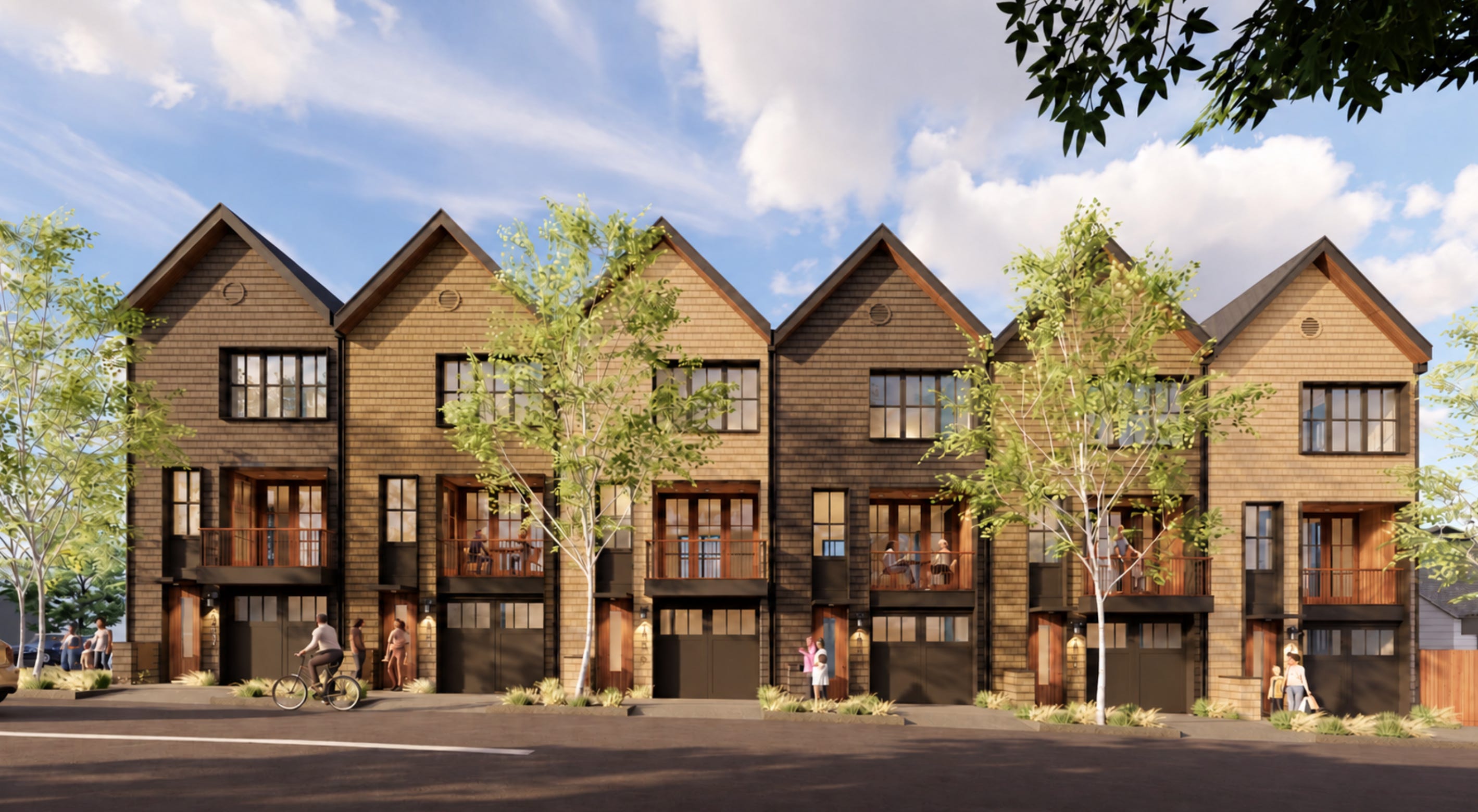
4 — The same developer has another Middle Housing project underway in North Berkeley called “Cedar Row”, which is replacing an old auto service station with a 6 unit row-house of for-sale 3 bedroom homes dressed in brown shingles. Again, this developer is using a combination of state law and the local Middle Housing ordinance’s density standards and streamlining.
5 — Another Middle Housing project fused with the state’s SB 684 was proposed for West Berkeley in the industrial section on a vacant lot. Four new single-family homes.
6 — A single-family homeowner is replacing their house with a duplex in West Berkeley.
7 — A single-family home is proposed over a detached garage in South Berkeley.
8 — Another fourplex has been proposed in West Berkeley’s industrial section.
9 — A re-purposed office will be converted into two rental units in the Elmwood area.
10 — The biggest and latest project of them all is a 6-story apartment over the site of a current preschool-to-8th grade campus in the North Shattuck neighborhood, adjacent to a brand new 7 story apartment building at Francisco and Shattuck Streets.
This project’s size was made possible because the lot is huge. At 12,000 square feet, Middle Housing’s 70 unit per acre density regulation entitles a project to a base density of 20 units. Combined with state density bonus law, designating 15% of the units to very low income households and 15% to middle income households (basically the same as market-rate), rewards the project with 20 additional apartments. Considering 51 parking spaces are planned for 40 units, this will likely be housing oriented toward families with children.
And that’s year one of Middle Housing projects.
Nearly every project has remained low-density enough to avoid triggering the city’s 20% affordable housing requirement. The middle-housing projects can’t afford to put low income, subsidized units on-site without a lot of market-rate units to cross-subsidize them; creating a weird “missing middle” gap where projects remain in the single digits of low density dwellings, or are essentially forced to use the density bonus and become mid-rise apartments. Anything in between doesn’t appear to pencil, as a pre-Middle Housing 10-unit townhome project at Berryman and Bonita Streets (pre-Middle Housing) collapsed trying to pencil 3 subsidized units. (I’ve discussed the origins of affordability mandates and the state density bonus here.)
Still, the initial projects look great. At a recent North Berkeley meeting, my older neighbors who are typically antagonistic to new housing extolled the designs of several projects. What’s shocking is how quickly two of them have already started construction.
— A Cultural Shift In Planning —
In the lead up to the passage of the Middle Housing ordinance, the opposition’s rhetoric grew in apocalyptic intensity, but none of their predictions came true. Opponents argued in newspapers, emails and on the dais that Middle Housing would gentrify South Berkeley with a swarm of predatory developers because land values were cheaper there, or mass evict tenants, or erect ungodly high-rises on suburban streets. In fact, 75% of the proposed units were in higher-income neighborhoods, just as I told them they would be. There were no evictions, due in part to Berkeley’s unprecedented anti-displacement ordinance written by the Rent Board, and the projects have not included any pencil towers amidst suburban homes.
It’s worth remembering this very recent history of failed predictions as the city now moves on to the latest battle: the Corridor Zoning Update. As I’ve discussed, The Elmwood and Solano Avenue neighborhoods are the whitest neighborhoods in all of Alameda County, and the state has required that segregated communities using exclusionary zoning integrate with denser housing containing a variety of income levels.
The corridor upzonings will carry the bulk of subsidized, low-income housing in these neighborhoods that currently have none since they’ll be dense enough to provide low income housing at the city’s 20% affordability level. As we’ve have already seen, the Middle Housing ordinance is primarily aimed at housing for middle-income residents because it’s not dense enough to trigger or fund subsidized, low-income units.
The latest argument is that if we allow some mid-century parking lots, banks and a 7-11 to become mixed-use housing, then the Elmwood, Solano and North Shattuck shopping districts will be destroyed. Two large development projects have stalled downtown, and the latest variant of opposition to Berkeley’s housing plans, Save Berkeley Shops, argue that they want to avoid stalled projects like the ones Downtown in their high-resource neighborhoods. Anti-upzoning activists commissioned a video and scattered posters, lawn signs and flyers around town—blaming the upzoning, the city council and the YIMBY movement for two blighted blocks downtown of stalled high-rise housing developments. (Note that the YIMBY movement didn’t exist when the Downtown Plan was passed and no one on city council currently had anything to do with the Downtown Plan of 2010).
Every single time I ask them to actually go into the tiniest bit of depth about why those two Downtown projects stalled, no one wants to discuss it. Not one. That’s because it was the voters who passed the upzoning of Downtown Berkeley in 2010, known as Measure R, which among many things called for 2 residential 18 story high-rise buildings. The old anti-growth coalition failed to stop the measure, twice, but subsequently fought every high-rise apartment proposed, starting with the Shattuck Cinemas redevelopment first proposed in 2011. They used every mechanism available to delay and stop it, including lawsuits, landmarkings, and adding infeasible conditions to projects. (The Battle of Harold Way even has its own subject page on Berkeleyside.)
After seven years of battle, State Senator Nancy Skinner of Berkeley passed a state law in 2018 to limit all public meetings on housing projects throughout California to five, which was clearly inspired by the 36 meetings the Shattuck Cinemas project went through. Moreover, Berkeley was sued and lost in court over the Housing Accountability Act, making it a statewide standard that no city in California can reject a zoning compliant project. With legal clearance provided, a flurry of developers by 2020 started proposing large downtown housing projects nearly a decade late after Berkeley voters asked for them—just as rising steel prices and interest rates brought housing construction to a halt, leaving a portion of Center Street blighted and stalled for a year now and counting.
Save Berkeley Shops and its allied candidates for city council are running with a new line that Downtown Berkeley’s recent stalled project issues are the inevitable consequences of upzoning. It’s a compelling argument if you simply don’t look at literally any other upzoned areas besides Downtown Berkeley. Oakland’s upzoning of downtown and North Oakland got at least a dozen housing towers built in the same time period Berkeley couldn’t build one. Emeryville, Temescal, Rockridge, El Cerrito, even Berkeley’s Southside Campus area doesn’t have the same stalled project blight problems that Shattuck does from home construction despite upzoning.
Downtown Berkeley’s blighted blocks are hardly about upzoning and more of an indictment on Berkeley’s old planning culture where the process of talking about building housing and offering endless opportunities to litigate, debate and block projects was considered successful community policy, rather than building housing like the majority of voters asked for. (Not that this is any excuse for inaction to unstall these projects; we can’t live in the 2010s forever but revisionism about it is nonsense).
The Middle Housing ordinance was unusual by City of Berkeley standards in that it was outcome-oriented. Unlike the old process-oriented Downtown Plan or the neighborhood zoning system before it, Middle Housing’s success is measured by how many homes its builds rather than how many meetings, appeals, concessions and extractions can be had. By granting building permits to projects in 30 days once the Planning Department determined their safety and compliance—skipping political review boards and foreclosing appeal attempts by opponents—projects are far less likely to lose funding and stall out like Downtown.
It’s already borne fruit: two Middle Housing projects, new owner-occupied homes for families in housing starved North Berkeley are currently under construction just one year from their initial submission. This speed is unprecedented in Berkeley’s recent history.
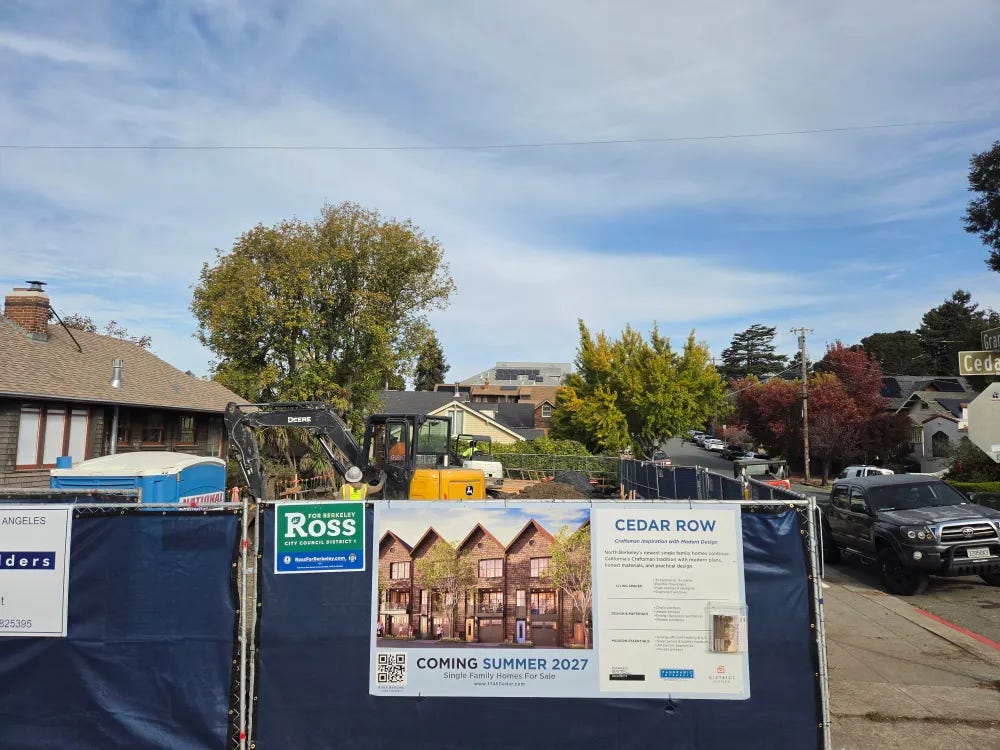
There is no way to avoid conflict in a city like Berkeley with a population of such divergent generational views. Berkeley is in a long tug of war between a population who grew up in middle 20th century suburbia and a population who favors new urbanism. This is reflected in the lawn signs of More Homes vs. Save Berkeley Shops, just as it was reflected in the BART housing signs, the Downtown housing signs before it, and likely more dueling lawn signs for years to come.
—
While writing an article detailing Downtown Berkeley’s history I came across these old 2010-era Downtown Plan Measure R YouTube videos featuring “NIMBY Robot” (made by a proto-YIMBY) vs. “Developer Councilmember Robot” lampooning Mayor Tom Bates.
Good times. And a reminder heading into election day that these debates in Berkeley aren’t anything new. Almost word for word the same stuff said today was being said back then.
Great article, and also it's great that the Middle Housing ordinance is resulting in middle housing.
"Opponents argued ... that Middle Housing would gentrify South Berkeley with a swarm of predatory developers because land values were cheaper there... In fact, 75% of the proposed units were in higher-income neighborhoods, just as I told them they would be."
Developers go where the money is, to the richer neighborhoods where they can charge more rent or a higher purchase price. Developers want money, what a shocker.