
Disclaimer: This article and all my articles do not represent the opinions of my employer, its affiliate university, or any public commissions I serve on. All articles in this publication are the opinions of only me.
Note that I have not worked in state-level advocacy for two years nor on this law, so my theories as to what this law does is not first-hand knowledge, but observation and speculation.
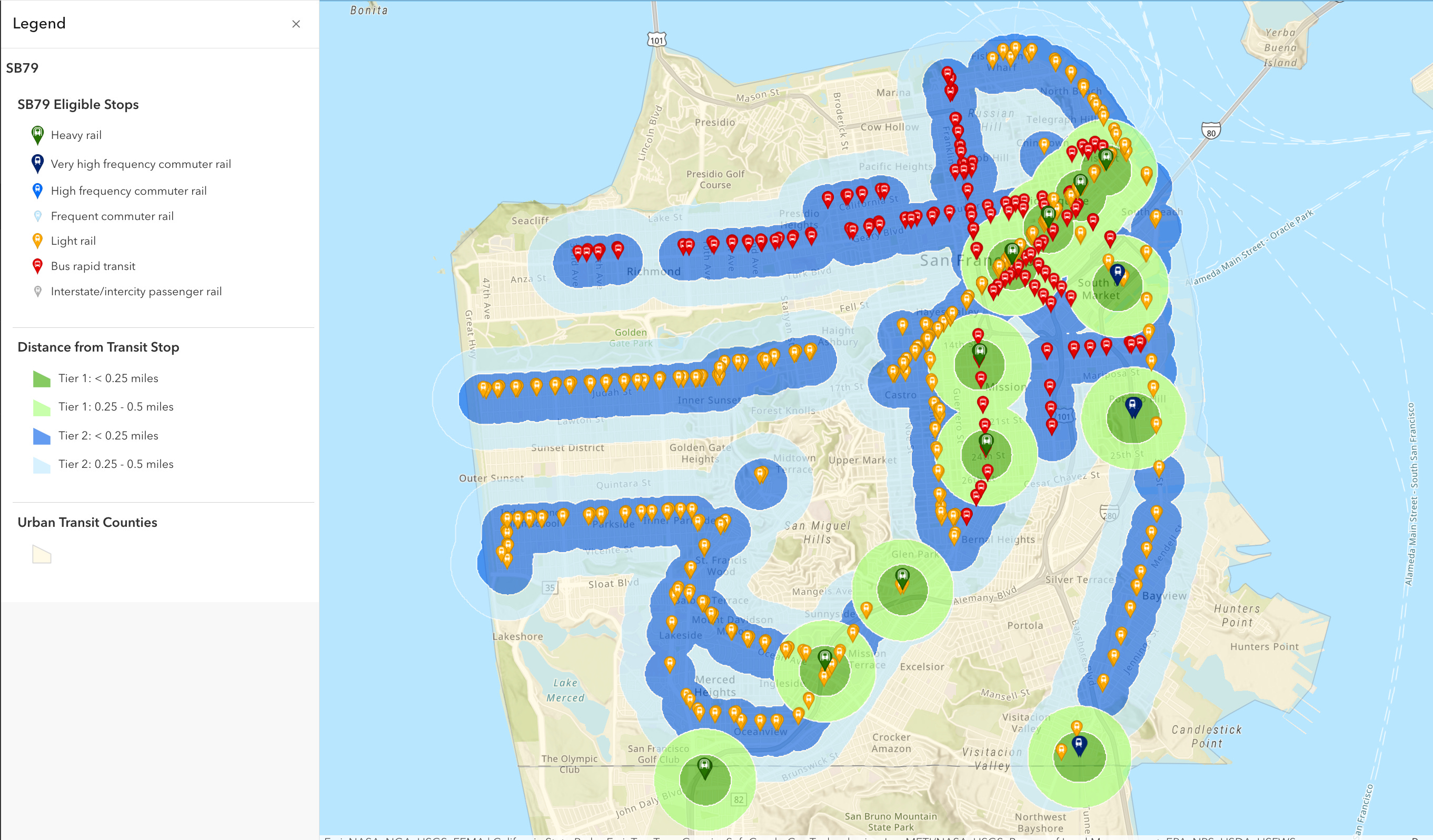
This is a high-level map of SB 79 made by a third party. It’s mostly accurate from my observation. Contra Costa County is no longer included.
—
Last Friday, the Senate passed the final vote on Senate Bill 79 — the more homes by transit bill. The passage of SB 79 ranks as one of the largest upzonings in the country. This is the culmination of 8 years of legislative battle started by state senator Scott Wiener of San Francisco to allow dense housing by transit with the intent to ensure that taxpayer investment into public transit results in a commensurate amount of riders using it. All that is left now is for the governor to sign it, which is all but certain.
Compared to SB 79’s initial version, and compared to the original vision in 2018 when it was first proposed as SB 827, SB 79 has been considerably scaled down. But the scaling down was not in its effectiveness to build housing, but in scope, and that’s a key difference than prior state laws passed in California.
SB 79 zones for multi-family housing near transit. If the transit is a heavy-rail line (a high capacity metro like BART, LA Metro Red-Line, or Caltrain), a developer can build multifamily homes as tall as 7 stories within a 0.25 mile radius of the station, or 6 stories within a 0.5 mile radius.
If the transit is light rail (small train vehicles like a tram or streetcar, or a bus stop used either by a bus rapid transit service or two high-frequency lines at a stop with a 24 hour bus-only lane), housing can be 6 and 5 stories within 0.25 and 0.5 mile radius, respectively. Providing that any portion of a parcel is within range of the pedestrian entrance of a transit station, SB 79 can be utilized. There are going to be many legal questions as to what constitutes a transit pedestrian area or whether a parcel is in range.
Many suburban dwellers will be concerned about the tall height limits, but the density limits are quite low. A 5,000 square foot lot (a common Bay Area residential lot size) allows for 13 homes near a high-frequency rail stop. 13 units is a 3-story building in most cities. The tall height limits are ideal for large lots, not small ones.
— Exemptions —
SB 79 has two exemptions. First, “urban transit categories” stipulates that a county must meet an arbitrary number of passenger rail stops (16) to be affected by SB 79. SB 79 already mandates that no train stations are upzoned unless they are served by at least 48 daily trains. Undoubtedly, this was to exempt rural and certain suburban legislators from having their commuter Amtrak stations upzoned.
SB 79 only applies to counties with 16 or more passenger rail stops: Alameda, San Francisco, Santa Clara, San Mateo, Sacramento, Los Angeles, Orange, and San Diego counties. Shortly after SB 79’s introduction, legislators sought to exempt themselves as they have with prior housing laws. This began with the infamous “Marin exemption” in SB 79’s predecessor proposal, SB 827. Originally, the threshold for urban transit counties was 15 rail stops, but it was bumped to 16 in Senate Committee. The cause of the bump is unknown, however the impact was significant and singular: only Contra Costa County and its 12 BART stations and 3 Amtrak stops were excluded with the change.
In cities with populations smaller than 35,000 people, SB 79 only upzones within 0.25 miles and not 0.5 miles. This was done in favor of small-town legislators in relatively urban areas, proclaiming to want only half the upzoning of bigger cities due to a swell in housing, causing outsized population growth. They actually shrunk the area by 75% per the formula for the area of a circle.
— Local & State Control —
SB 79 allows local communities, if they choose, to redraw alternative zoning plans for SB 79. By July 1st, 2026, SB 79 will automatically activate, absent any alternative plans. Cities can move around density within a station area or add more density to one station by taking it away from another. However, no variant of a local plan can reduce an individual station area’s upzoned density by more than 50%. These plans must be approved by the state housing agency within 90 days.
This provision was made to appease legislators who oppose state control of land use. SB 79 still allows for a lot of local control. Beyond the minimums established, cities can otherwise regulate development however they wish. That includes setback requirements, lot coverage rules etc. The only prohibition is that no regulation can apply to SB 79 projects exclusively.
However, SB 79 does circumvent local zoning laws and development requirements if it contains low-income housing, which is required of all projects 10 units and above. 1, 2, or 3 local regulations can be ignored depending on whether the low-income housing is for low-income, very low-income or extremely low or no-income households, respectively.
Density bonus projects in California currently can ignore all local zoning laws if they provide enough low-income housing to trigger a bonus. Density bonus projects in SB 79 are surprisingly more tightly restricted. And the height limit in SB 79 cannot be ignored under any circumstances. As a result, as far as building heights go, SB 79 is actually more restrictive than many local zoning laws as far as building heights go,.
— Affordability Requirements —
SB 79 mandates that low-income housing must be built in projects 10 units and greater: at least 7% extremely low income, 10% very low income or 13% low income. If housing is on transit company lands, the requirement is increased to 20% subsidized housing and 25% if its mixed use. If a local community has a higher citywide affordability requirement, then projects must defer to that. While developers do not like affordability requirements, SB 79’s affordability rate was based on existing state law that has proven widely used.
Originally, SB 79 simply deferred to local community laws on subsidized housing requirements. Statewide minimums were included after left-wing legislators and nonprofit developers objected to the lack of subsidized housing mandates in the law, especially for public lands.
In its first draft, SB 79 was designed to transition American public transit land-use standards to international standards like that of Japan, where transit agencies get supplemental income from real estate development and economic activity to fund transit service. The legislature changed it to be more focused on abiding by the existing state surplus land act standards: using public lands for public services first.
— Demolition Controls —
To prevent displacement of current renters in low-density properties affected by upzoning, SB 79 can only be used on parcels that demolish single-family homes or duplexes / 2 units. It’s a bit unclear how this works with mobile home parks and Assemblymember Aisha Wahab hinted that a fix for that can be added next year.
SB 79 cannot be used on properties that require the destruction of homes with 3 or more rental units that have been subjected to price controls. State law has imposed anti-rent gouging controls on all multi-family homes built before 2014. It’s unclear if SB 79 can be used on parcels that simply move 3+ unit homes to a different location, either on-site or off the parcel. If the 3+ unit homes on these parcels are destroyed for whatever reason, SB 79 cannot be used there for at least 7 years, regardless of whether it was vacant or occupied.
State law from 2019 generally prohibits the demolition of rent or price-controlled housing without a replacement unit at the same rent level and relocation services paid during construction. These extra provisions in SB 79 were passed at the request of tenants’ rights organizers.
— Labor Requirements —
SB 79’s passage was made possible due to the powerful Building Trades dropping their opposition and other labor unions, including the Carpenters Union, endorsing the law. The labor agreement was that housing projects 85 feet and over (so eight stories), and housing projects on transit agency properties would be built exclusively by unionized labor.
Although SB 79 by default doesn’t zone higher than 7 stories, alternative local plans can focus on higher density and height exceeding 7 stories in fewer areas. Online, some developers seem annoyed with this agreement, but 8-story buildings are usually built with steel, and typically, the labor is exclusively skilled union workers.
This satisfied the Building Trades, who are construction union laborers who prefer union exclusivity and training opportunities on building contracts. The Carpenters Union, who are primarily residential laborers, doesn’t prefer exclusivity since non-union employment allows for opportunities to organize. This labor agreement saved SB 79 from death.
— Enforcement —
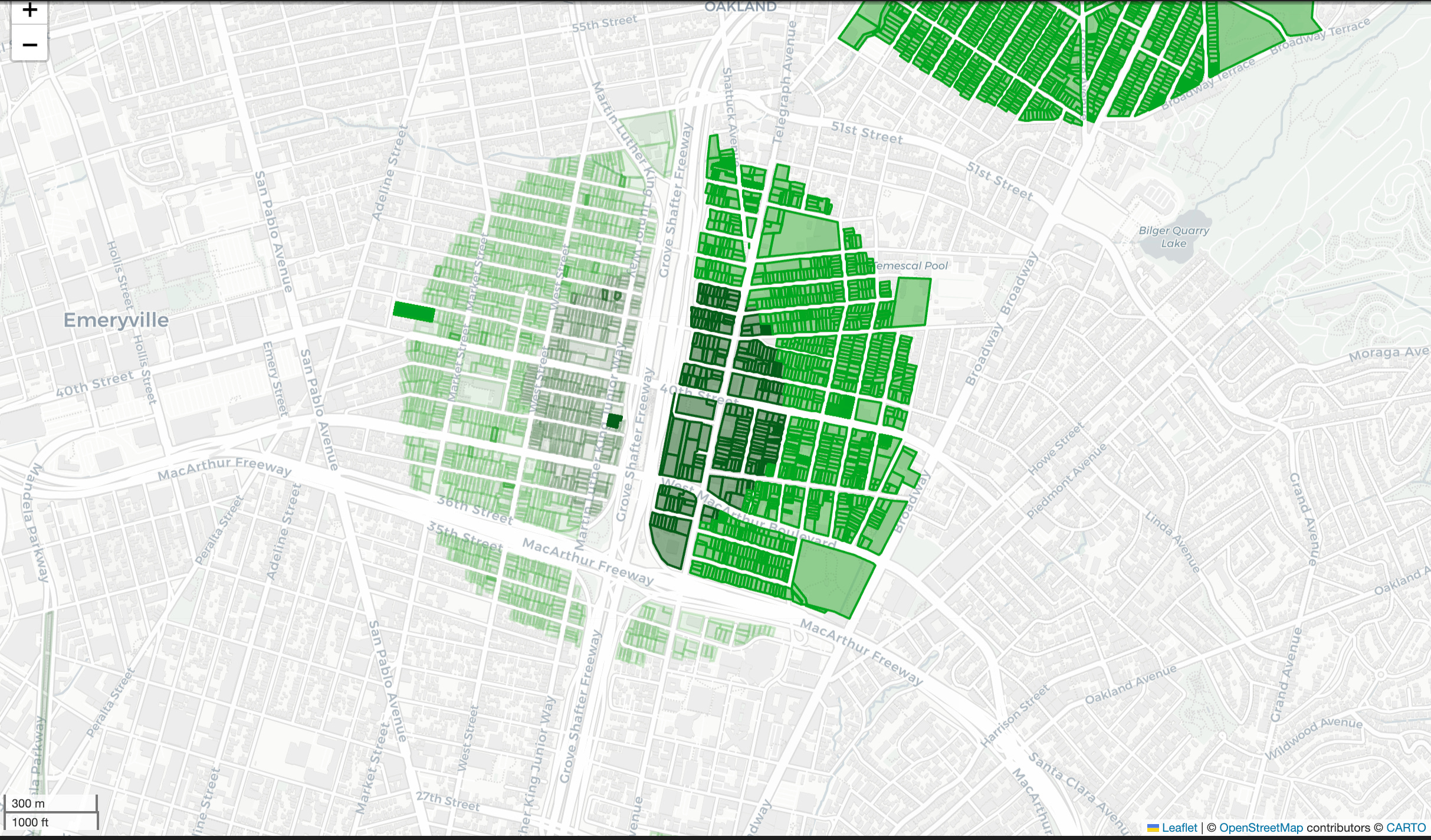
Another major agreement was between the YIMBYs and housing justice nonprofits. This manifested in the delaying of SB 79 in state-designated low-income neighborhoods until the next Regional Housing Needs Allocation cycle, which won’t be in LA or the Bay Area for another half-decade. This delays almost half of SB 79’s upzoned areas and requires cities to spend five years to consider alternative transit plans or accept the default. Housing justice groups have consistently tried to exempt low-income areas in prior state housing laws because they argue that market-rate development can cause displacement and gentrification. Thus, more careful planning and time are needed in these neighborhoods. Low-resource areas constitute large swaths of Los Angeles, Oakland, and San Jose.
Any projects proposed in middle-class areas (identified as Moderate Resource by the state) that are wrongfully rejected by local governments can go through the standard appeals process in California. But local governments rejecting projects in upper-middle and high-income neighborhoods (High and Highest Resource) will be immediately penalized without appeal.
This particular provision satisfied most of the Equity nonprofits and tenant union organizers. Inner City Law Center formally announced the removal of nearly all tenant groups and equity nonprofit opposition ahead of the key Assembly floor vote. You can see a map of resourced areas here. Low Resource areas, in lime green, are delayed areas.
With all these concessions, agreements and provisions in place, Senate Bill 79 passed Senate, Assembly and Senate Concurrence. Eight years of battle over transit-oriented upzoning came to an end. It’s en-route to the governor’s desk where there is little doubt that he’ll sign it.
—
Correction: Originally, this article said cities must submit alternative plans by July 1st, 2026. That was a misunderstanding: bill sponsors have confirmed that there is no deadline to submit a plan, just that SB 79 activates absent one in 2026.
"Moreover, if a city is behind in its low-income housing quotas, current state law drops their affordability requirements to 10% no matter what it was initially set at." What state law is this? I live in the SF South Bay, where few or no cities have met their low income requirement and some cities have inclusionary requirements above 10%.