Berkeley's Last Zoning Battle
Three high-income Berkeley neighborhoods prepare for battle over a zoning plan that'll add housing to their commercial districts.

Disclaimer: This article and all articles I write do not represent the opinion of my employer or the public commission I volunteer on. All my articles on my blog represent only my personal opinion.
Reading Part 1 isn’t necessary but provides some economic context I’ll reference in this piece.
Why are we doing this upzoning plan in Berkeley, and what’s it got to do with destroying Berkeley shops? A quick history lesson:
In 1916, the developer of exclusive Berkeley neighborhoods got the city council to pass an ordinance prohibiting multi-family housing and later segregating commercial uses in Elmwood. Although there were competitor ordinances elsewhere, housing academics typically cite Elmwood as the birthplace of exclusionary zoning.
In 1963, Berkeley activists attempted and lost a Fair Housing referendum banning race and sex consideration in housing. Eventually Fair Housing became national law in the Civil Rights Act of 1968. “Affirmatively Furthering Fair Housing” was put in the law by Senator William Proxmire, who argued that banning race discrimination was insufficient because suburban communities were using low density zoning to keep out multifamily homes, which were more affordable. The 1964 NBC segment Segregation: Western-Style showcases how the Claremont-Elmwood area practices this.
In 2018, California mandated that “Affirmatively Furthering Fair Housing” in zoning practices must encourage multi-family housing in wealthier areas to expand housing accessibility. (The Obama Administration pushed these guidelines in 2015 but Trump suspended it in 2020.) In 2022, Berkeley’s Planning Department identified planned population increases (known as up-zoning) for West Berkeley and BART station zones as sufficient for 9,000 more homes.
West Berkeley councilmembers noted this didn’t conform with the new rules. Since 1980, Berkeley has focused thousands of new homes and households on commercial zones in the working class and campus areas. Meanwhile, wealthier census tracts like Elmwood-Claremont, Shattuck north of Cedar Street, and Solano Avenue have added only a net increase of 58, 35 and 0 homes since 1980, respectively.
In 2022, the city council selected North Shattuck, College Avenue (Elmwood) and Solano Avenue commercial zones for upzoning, because they have frequent bus service, are in or near “high income and resource zones” (while not being in fire zones), and are in or near historically white-only districts. Claremont-Elmwood and North Berkeley are classified by state as “Racially Concentrated Areas of Affluence” and by UC Berkeley’s Othering and Belonging Institute as “High White Segregation.”
This rezoning plan had been supported by pro-housing and YIMBY groups, and principally by East Bay Housing Organizations, which advocates for low income non-profit developers. In contrast, the city’s biggest market-rate developer, Patrick Kennedy, said he didn’t think the plan was worth the backlash. YIMBY groups had called for expanding the upzoning two blocks into the adjacent residential areas to increase housing and discourage business disruption, but planning staff shot the idea down due to Middle Housing.
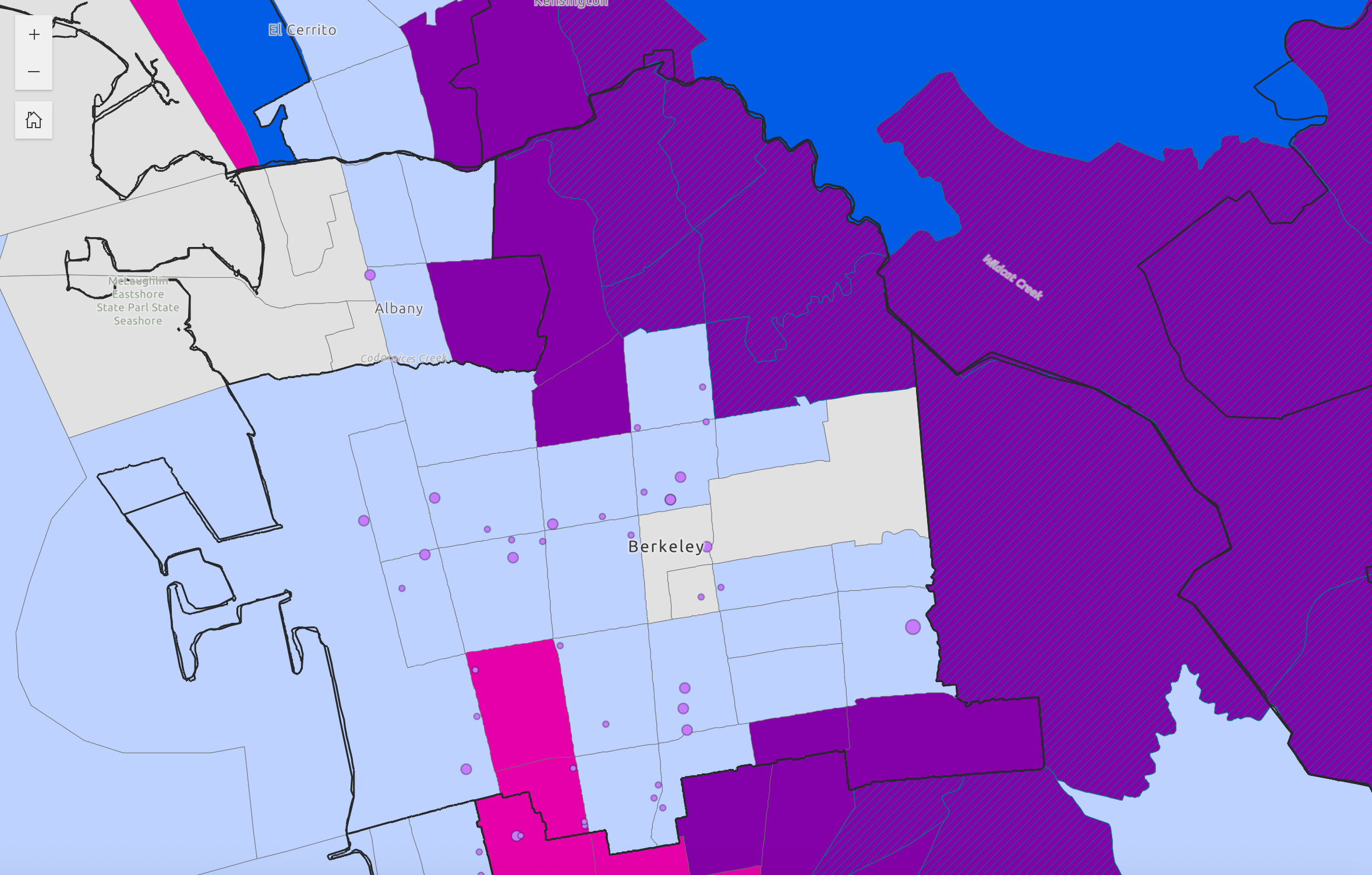
In 2022, when Berkeley submitted these corridors to the state for planned upzoning, staff had failed to set any specific housing goals. HCD then declared that the city’s zoning plan was “out of compliance.” If the deadline has passed and the state rejects a city’s zoning map, a penalty is activated known as Builder’s Remedy, where developers can build high-density apartments almost anywhere in a city, provided a portion of the project is low income or completely middle income.
Santa Monica was the first city to fall out of compliance and the city was besieged with proposals for 4,000 homes, mostly in towers, within one week. No Builder’s Remedy projects were attempted in Berkeley because it was untested law, but by 2024, the legislature codified and cleared legal ambiguities. Dozens of cities throughout California are currently affected, and the attorney general is fining cities that don’t comply.
In 2023, the city of Berkeley and the state finalized three concrete pledges on Page 144 and 157 of our zoning plan that puts Berkeley back into compliance and restored local zoning:
At least 2,000 more homes particularly on College Avenue (Elmwood), Solano Avenue, and north Shattuck Avenue commercial areas;
Consistency in zoning between high-income corridors and corridors in formerly red-lined neighborhoods (West and South Berkeley);
That points 1 and 2 are completed by the deadline: December 2026.
If Berkeley is “out of compliance” come January 2027, not only could our local zoning from the waterfront to the hills be suspended, but the state could also withhold funding for our low-income housing projects. The initial rejection already said on Page 3 that Builder’s Remedy would be activated if the city’s plans weren’t completed:
Please be aware, if the City fails to adopt a compliant housing element within one year from the statutory deadline, the element cannot be found in substantial compliance until these rezones are completed
Then the community feedback process began. A city poll of 1,000 found most respondents supported increasing height limits on the three corridors, but that two-thirds of Elmwood neighbors were completely against increasing theirs.
Then a group of citizens formed Save Berkeley Shops with two primary arguments well-emblazoned on their lawn signs: that upzoning and housing construction would evict merchants and destroy vibrancy; and that high-density housing would ruin their suburban way of life.
They frequently point to Downtown as ruined by housing, although Berkeley’s sales tax data shows that Downtown grew much faster than Elmwood and Solano Avenue in shopping activity between 2014 and 2022—but has stagnated since. Downtown has a lot of issues, but that’s a complex problem for its own story.
Given the limited geography of the upzoning upon only small commercial districts, there is undoubtedly higher risk of merchant displacement from future housing projects. Rumors spread that a 20-year old North Shattuck cafe was evicted in anticipation of upzoning, despite its parcel being too small to build on. People feared Elmwood Theater could be demolished despite it being both a landmark and owned by a nonprofit.
At least half the city council voiced support for equality of zoning between West Berkeley and the high-income corridors—meaning 7 story zoning universally. But, at the recommendation of merchant advocates who wanted housing but without disruption, the Planning Commission made a compromise ordinance that reduced the upzoning to big parcels: mostly banks, supermarkets, parking lots and strip malls.


The commission set height limits for these specific parcels to 5, 6 and 7 stories for College, Solano and North Shattuck based on a measurement of street width comparable with San Pablo Avenue’s with an extra floor to compensate the removal of zoning changes from the vast majority of shops.
The Planning Commission is only an advisory board so this plan will be edited and debated when it goes before City Council.
On the positive side, the current plan accomplishes an estimated 1,700 homes best case scenario. Even universal, 7-story up-zoning was only 1,800 homes because the smaller parcels with most of the businesses were too small to fit modern apartments.
However, there is an issue that supporters of the upzoning have complained about. The spot-zoning isn’t being done for San Pablo Avenue, which is also being upzoned to 7 stories and which relates to point 2 of the state agreement: zoning equality.
Save Berkeley Shops doesn’t appear to include West Berkeley—either on their website or at the hearings. Because West Berkeleyans are historically supportive of new housing, opponents have argued that Berkeley can get by just with upzoning San Pablo Avenue, but the state has already said that high-income neighborhoods must contribute or else.
The Planning Commission’s recommendation has so far been applauded by North Berkeley and Elmwood’s councilmembers as a major compromise that exempts a majority of the shops and build homes. However, Save Berkeley Shops hasn’t appreciated any of it. After most shops were exempted, they voiced opposition to making any ordinance at all—despite state mandate—and said that these exemptions probably wouldn’t make any difference. After the commission heeded their request to ban lot mergers, they followed up in their newsletter only to say that Elmwood and North Berkeley faced an “existential threat” of “Manhattanization.”
The vast majority of upzoning opposition is coming from the Elmwood district, even though its total contribution is just 140 expected homes versus 1,400 in North Berkeley. (The Elmwood shopping area is only 2 blocks in length; hence enhancer upzonings have since been proposed for southeast Berkeley to actually contribute more housing). Elmwood opponents argue that just one housing project can destroy the businesses simply by being adjacent to construction sites or eight story buildings.
This argument doesn’t work well in North Shattuck since its southern end has gradually absorbed denser housing over the past 20 years with improved diversity and business vibrancy. An 8-story apartment was just completed next to a dense cluster of popular shops without issue, and a popular cafe opened next door during construction.
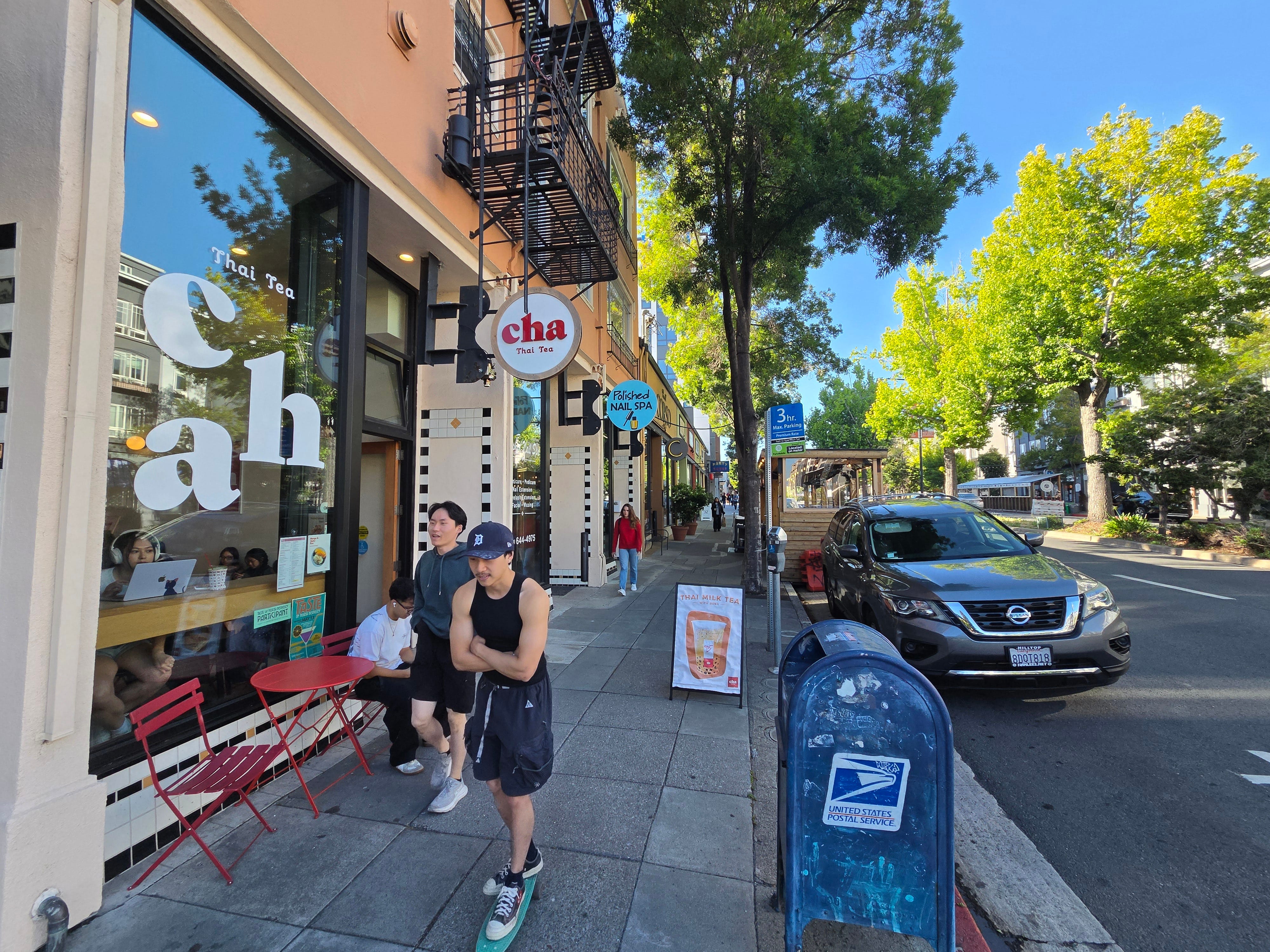
The housing issue is more theoretical and intense in Elmwood because gradual housing growth of all types has been blocked there for 40 years:
In the 1980s, the Claremont-Elmwood association locked the University of California into a 50-year development agreement prohibiting more housing at Clark Kerr campus until 2032.
By 1990, Elmwood and North Berkeley broke Berkeley into a district-based election system after the city council proposed 2-story public housing in their neighborhoods.
In the 2000s, Elmwood merchants and homeowners opposed adding a single story of senior housing above Elmwood Hardware to finance renovations, causing the closure of the district’s major anchor business.
In the 2010s, the Claremont-Elmwood association fought 4-story condominiums at the Claremont Hotel.
And I won’t dwell on it, but I feel disproportionate opposition to the Middle Housing ordinance from last year came from Elmwood residents.
Nevertheless, the case for housing in these neighborhoods should stand by itself, not because of state mandate or Builder’s Remedy. Homes on these corridors would offer aging in place opportunities to many seniors, like my neighbor who struggles on her stairs but doesn’t want to lose her friend groups and local businesses by moving away.
A lot of seniors have been moving down from the Berkeley Hills due to fire risk and inaccessible homes, looking for condos and apartments close to Solano, Elmwood and North Shattuck. Most of the older apartments built around North Shattuck were banned in 1978, so there aren’t any modern ones with elevators.
New, multi-family housing on these corridors without displacing businesses that make these corridors great is a win-win.
I confess that the zoning plan put forward isn’t equal to West Berkeley, but this plan is a good, minimally disruptive, 8-year introduction of housing into neighborhoods that haven’t seen apartments in a century. San Pablo Avenue also has a lot more parking lots and autoshops, which developers prefer over dense business clusters.
There’s a lot of policies I wish we were talking about, like design. We could incentivize use of classical ornamentation rather than misguided obsessions about stepbacks and massing that make new buildings look like ugly Lego. Faux-classical buildings downtown played a major role in de-stigmatizing Berkeleyans to high-density housing. North Shattuck’s new 8-story building is welcomed in a neighborhood already supportive, but it resembles a Kleenex box. Solano and Elmwood would probably warrant some classical facade for their very first projects.
Renderings and conceptual height limits are often frightening and obsessed over, but nobody in the real world notices the difference between a 3 versus 8 story building while walking on a corridor. Pedestrians engage with buildings on their ground floors. New buildings have so far put uninviting resident services in front rather than maximizing ground floor retail. Retail needs to be in front on commercial corridors, resident services on side streets or minimized on commercial corridors, and retail spaces subdivided into smaller units so they lease up faster at more affordable rents. It’s the big retail floor spaces staying empty for so long.
I talk to the Save Berkeley Shops members a lot. A few are my neighbors, whom I love and respect, and with whom I sometimes spend hours arguing at Saul’s Deli. I know some of them don’t believe it but I do listen and sometimes agree with them. These people are not anti-fair housing or prejudiced. They love their communities as much as I do. I feel their fear is often rooted much deeper than policy. They fear that the places they love will change into something unfamiliar and uncomfortable.
I get it. I’m deeply sentimental about University and California Streets. I grew up on that corner. I took dates to the pizzeria. My friends smoked there. My family ate there constantly when I was growing up. And now it’s gone. In its place is a tall, modular apartment building.
I can appreciate the benefits of that housing pushing area rents down and bringing much needed businesses and customers, yet simultaneously mourn the loss of an experience that I’m sometimes unwilling to admit was changing anyways. Same with the loss of downtown movie theaters that opponents of this plan invoke constantly as a negative against building housing.
Blaming housing downtown distracts from the reality that Berkeley lost 30 movie theaters citywide; most of which are repurposed husks. Blaming housing distracts from why we’re older now and don’t fit in on Telegraph anymore. Blaming housing distracts from why your favorite diners downtown got replaced with new cuisine. Or why all the commercial districts in actual decline are hardly building any housing.
Elmwood is a lovely commercial district; one of the most well-kept in the East Bay. Today its main anchors are regionally-appealing food businesses. But the original preservationists of Elmwood in the 1970s fought the perceived invasion of restaurants appealing to outsiders with a business quota system to protect neighborhood serving retail and services. Yet obstructing housing ultimately did not save neighborhood-serving retail and service businesses and perhaps worsened it in Elmwood Hardware’s case. Were it not for the apartments being built in Southside and younger families moving to South Berkeley, packing Elmwood cafes and businesses with young people and families, Elmwood may be struggling like Solano Avenue clearly (and measurably) is today.
Twenty years from now, I’ll be sitting at the Elmwood Cafe with my family. Hopefully it’ll be more pedestrianized by then. I’ll be telling my children about the apartment with some popular shop beneath it that will have replaced the 7-11. I’ll tell all the stories about the failed predictions of doom and ruin that building was supposed to cause to the Elmwood.
And after hearing the story for the hundredth time, they’ll say: “Shut up, Dad. No one cares.”
—
Really informative article. Wish I was a "fly on the wall" to hear some of these discussions you had with the Save Berkeley Shops people. From your article it sounds like they are part of the problem they complain about - disruption to local stores due to construction. If they'd allow apartments in the residential blocks where they live, rather than just on the commercial corridors, then there'd be less disruption of stores on the corridors.